
How to be ready for the future, where to focus, how to ensure that also small and medium-sized companies can benefit from development, and how regulation is steering the near future — these were some of the core research questions of the DiHaLoT project, funded by Sitra and coordinated by Fintraffic in collaboration with Solita and Vediafi. All final results are published on Fintraffic’s website.
To address these questions, the project included three main tasks:
- Regulation mapping
- Digital logistics demo
- Sounding Board preparation
The goal of the first task was to collect all recent legislation affecting logistics and freight transportation. The aim was to compile this legislation into a single illustration and summarize how recent regulatory developments will guide the sector’s future.
As a result, 51 regulations were identified and divided into five categories:
- Logistics
- Transportation system & customs
- Economy, military & resilience
- Data & ICT
- Sustainability & environment
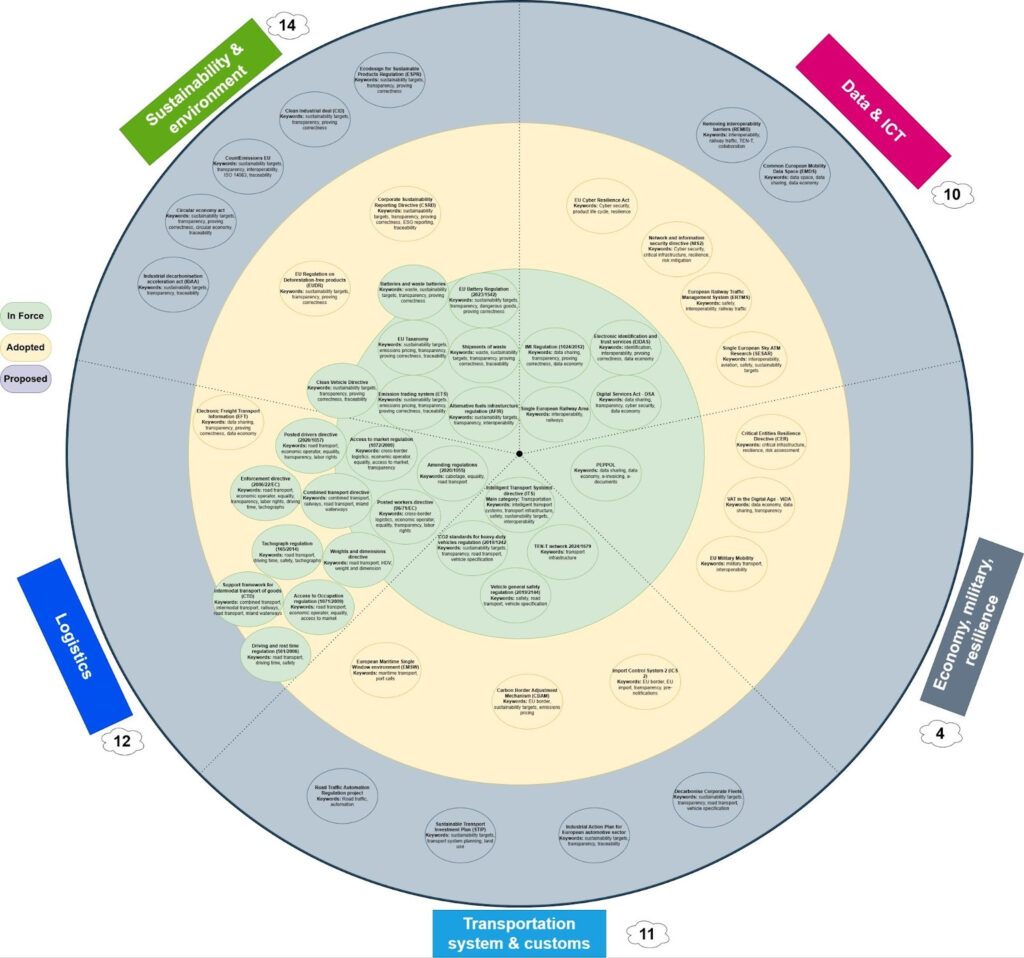
The main message of this mapping is that, in the future, companies operating in the logistics industry will need to integrate knowledge and expertise from multiple domains. While some of these competencies can be outsourced, a basic understanding of sustainability, ICT, and resilience must also exist within the company.
“So, if you want to be a winner in this game, start practicing the good old Trivial Pursuit.”
Before summarising task 2 and revealing the soul of the AI demo, let’s introduce the last task. The third task of the project focused on planning and preparing a market discussion forum (Sounding Board) for the Finnish logistics industry. This forum was envisioned as a bridge between national authorities and companies. The goal was to establish a cooperative network that would continue at the national level even after the DiHaLoT project.
The Sounding Board invited key stakeholders with broad perspectives and a commitment to promoting Finland’s logistics competitiveness through digitalization. Around 10–20 participants from the public sector, logistics service providers, customers, and industry associations were invited.
The aim was for the Sounding Board to serve as a platform for market dialogue between authorities and the private sector—allowing authorities to identify current challenges and goals related to national and international regulatory work. For companies, it offered an opportunity to influence the direction of development and ensure that their needs and expectations are heard.
As a result, Task 3 produced a practical plan and proposal for Finland’s transport and logistics sector on how to organize and coordinate such a market forum.
As mentioned above, the project also produced a demo, designed for communication and demonstration purposes. The final demo was built on top of an AI tool trained to summarize and process information for users. The demo can be found here: https://dihalot.fintraffic.fi/
The demo showcased the power of AI: with relatively little training and effort, an AI tool can already provide valuable guidance—for example, on emission calculations or regulatory requirements. While the tool remains a demo and users should be aware of its limitations, it is interesting to consider how much more training would be needed before the AI could deliver better results than a traditional consultant.
Topics such as emission calculations or eFTI implementation could easily be supported and guided by such AI tools—and likely will be in the near future. Please test the demo and share your feedback.