
When people discuss recycling, one challenge comes up again and again: lack of reliable data.
In traditional recycling processes, data is often fragmented, incomplete, or difficult to verify. Yet as batteries become one of the most valuable components in modern vehicles, accurate information is no longer a nice-to-have. It is becoming a necessity.
This is where DELV takes a different approach.
The DELV platform was built on the principle that vehicle lifecycle data should remain connected from first registration all the way to recycling and material recovery. Because DELV operates at the individual vehicle level and utilizes vehicle identification data together with trusted national registry information, the platform provides a solid foundation for high-quality and traceable recycling data.
The rapid growth of electric vehicles has introduced an entirely new category of high-value assets into the circular economy: high-voltage traction batteries.
While most of today’s EV fleet is still relatively young, battery recycling is already happening. Accident-damaged vehicles, hybrid vehicles, warranty replacements, and factory repairs are generating a growing flow of batteries that require safe handling, reporting, transportation, and ultimately recycling or reuse.
Battery Recycling Starts with Better Data
To address this need, DELV launched its Battery Recycling and Reporting portal in January 2026.
Since launch, the portal has been used daily by vehicle importers, distributors, and other stakeholders. The portal is expected to process its first 1,000 battery reports shortly, demonstrating that battery recycling is no longer a future challenge. It is a current operational reality.
The portal supports:
- Electric vehicle batteries
- Plug-in hybrid batteries
- Hybrid vehicle batteries
- Complete battery packs
- Individual battery modules
Reporting a battery through the portal is straightforward. Once submitted, the information is automatically forwarded to the official battery recycling operator, who coordinates transportation and ensures compliance with recycling requirements.
At the same time, DELV creates a digital data trail that connects the battery to its original vehicle and records key lifecycle events throughout the recycling process.
Data That Creates Real Business Value
Recycling is not only about compliance. The data generated through DELV provides insights that can help manufacturers, importers, producer responsibility organizations (PROs), and recycling operators better understand the market. Since battery recycling data is linked with vehicle fleet information and registration statistics, DELV can provide valuable intelligence such as:
- Recycling volumes by vehicle brand and model
- Battery retirement trends
- Regional developments
- Fleet composition analysis
- Future battery recycling forecasts
As battery regulations evolve, access to reliable lifecycle information becomes increasingly important. Data generated through DELV can also support Battery Passport initiatives by creating a trusted digital link between the vehicle, the battery, and key lifecycle events, enabling secure information exchange across stakeholders and digital ecosystems.
The Next Step: A Marketplace for Second-Life Batteries
During summer 2026, the DELV development team has been working on another major step forward: the Battery Marketplace. The marketplace is designed to support the emerging second-life battery economy by connecting trusted stakeholders within a transparent and traceable environment.
Instead of batteries moving directly towards recycling, suitable batteries can find new applications in energy storage and other secondary use cases. Initial results indicate that approximately 25% of batteries entering the recycling process may be suitable for second-life applications, creating significant opportunities for reuse before recycling. At the same time, PROs and authorities can maintain visibility into the process and monitor compliance with evolving regulatory requirements.
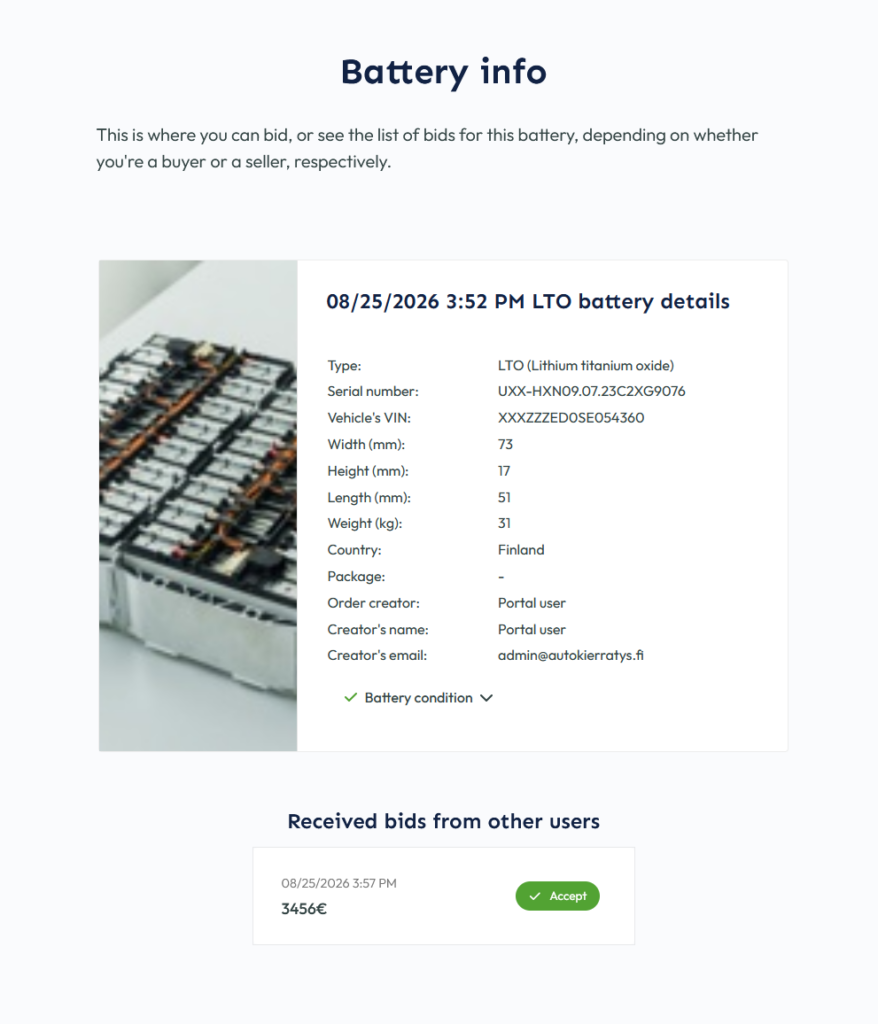
The Battery Marketplace is now approaching production launch.
Built in Finland. Ready for Europe.
Although DELV has been developed for the Finnish market, the platform was never designed as a country-specific solution. Its modular architecture, modern API-based integrations, and scalable data model make it adaptable for other markets and regulatory environments. As battery regulations continue to evolve across Europe, the need for reliable lifecycle and recycling data will only increase.
The future of battery recycling is not only about materials. It is about data, transparency, traceability, and creating value throughout the entire lifecycle.
If you are attending #ICBR2026, visit the DELV booth to discover how vehicle-level traceability, battery reporting, second-life marketplaces, and future Battery Passport services can be brought together in a single digital ecosystem.
We look forward to meeting you there.
-Lasse Nykänen